Back to scenarios

Safe trial and error in the virtual lab

Scenario walkthrough · Student · Virtual labs

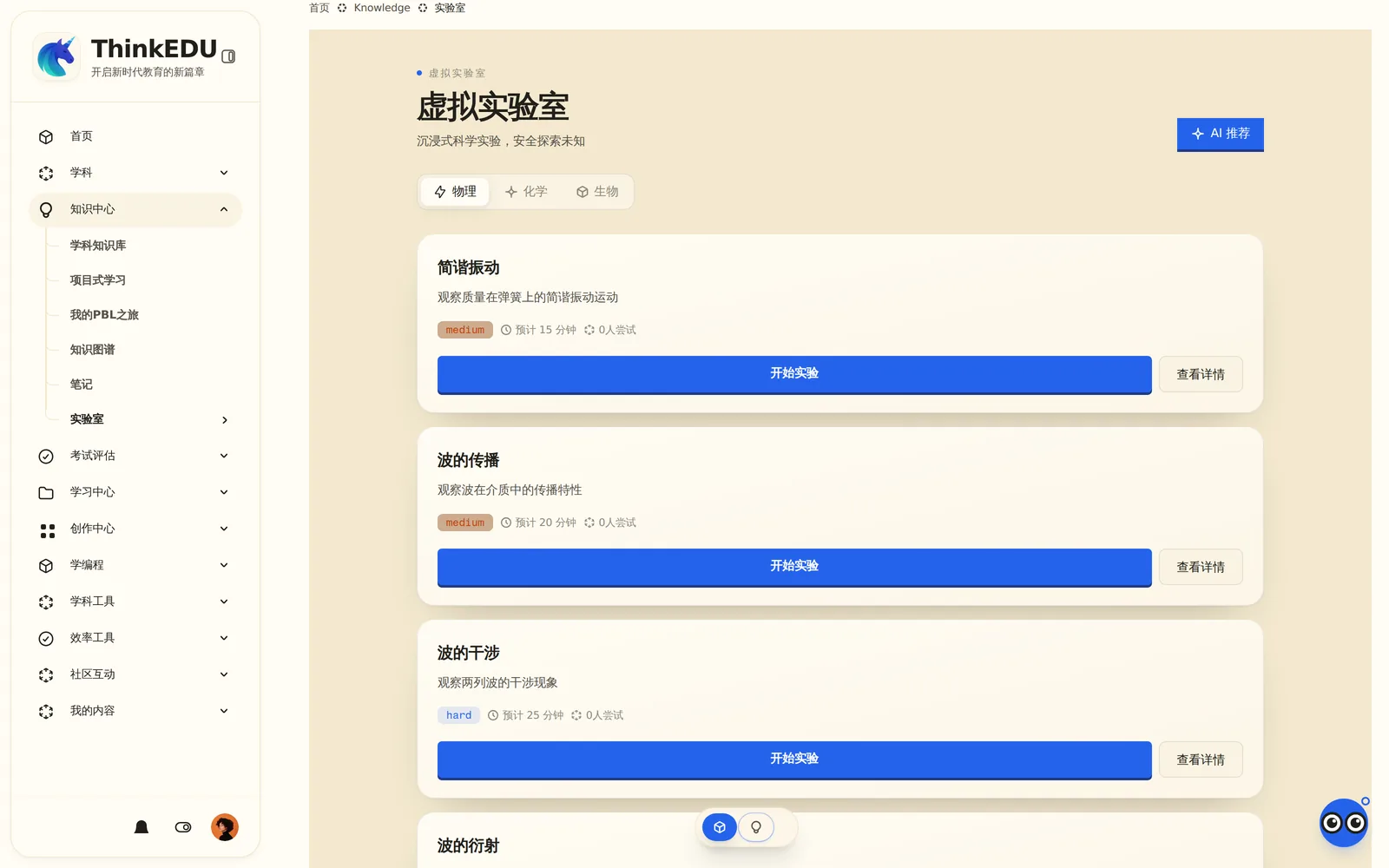
Hazardous reactions, costly apparatus, structures nobody can sketch — all running as interactive 3D experiments in the browser. A student can ruin the same experiment many times over just to see what one variable does, and every run is written up as a lab report and archived.

These are product scenario walkthroughs showing how Think EDU works inside a real learning flow. They are not client case studies, and they do not represent outcomes from any school or student.

Safe trial and error in the virtual lab

The real difficulty

Over a term, many experiments happen only once, demonstrated at the front of the room. Students see the result, but never get to change a variable themselves, get it wrong, and look again at what shifted.

How Think EDU works here

Chemistry, physics, and math experiments run interactively in the browser, with variables free to change as often as needed. At the moments that matter, Dr. Siwei asks: “If you halve this, what do you expect to happen?” — prediction first, verification second. The lab-report tool turns each run’s steps and conclusions into a record that sits on the same evidence timeline as homework and projects. Abstract math structures are rendered through the Manim animation pipeline, and chemistry equations can be recognized and animated.
What this scenario leaves behind

  • Failure costs nothing, so a student can rerun the same experiment many times just to isolate one variable.
  • Each run is archived as learning evidence with its steps and conclusions — not a lab report reconstructed from memory afterwards.
  • What used to be invisible — how molecules react, how a function deforms — becomes an animation that can be watched again and again.

Next scenario: From one photo to a cross-subject inquiry

View scenario