Back to scenarios

When homework stalls, the wrong step gets circled — not the answer handed over

Scenario walkthrough · Student · Homework and review

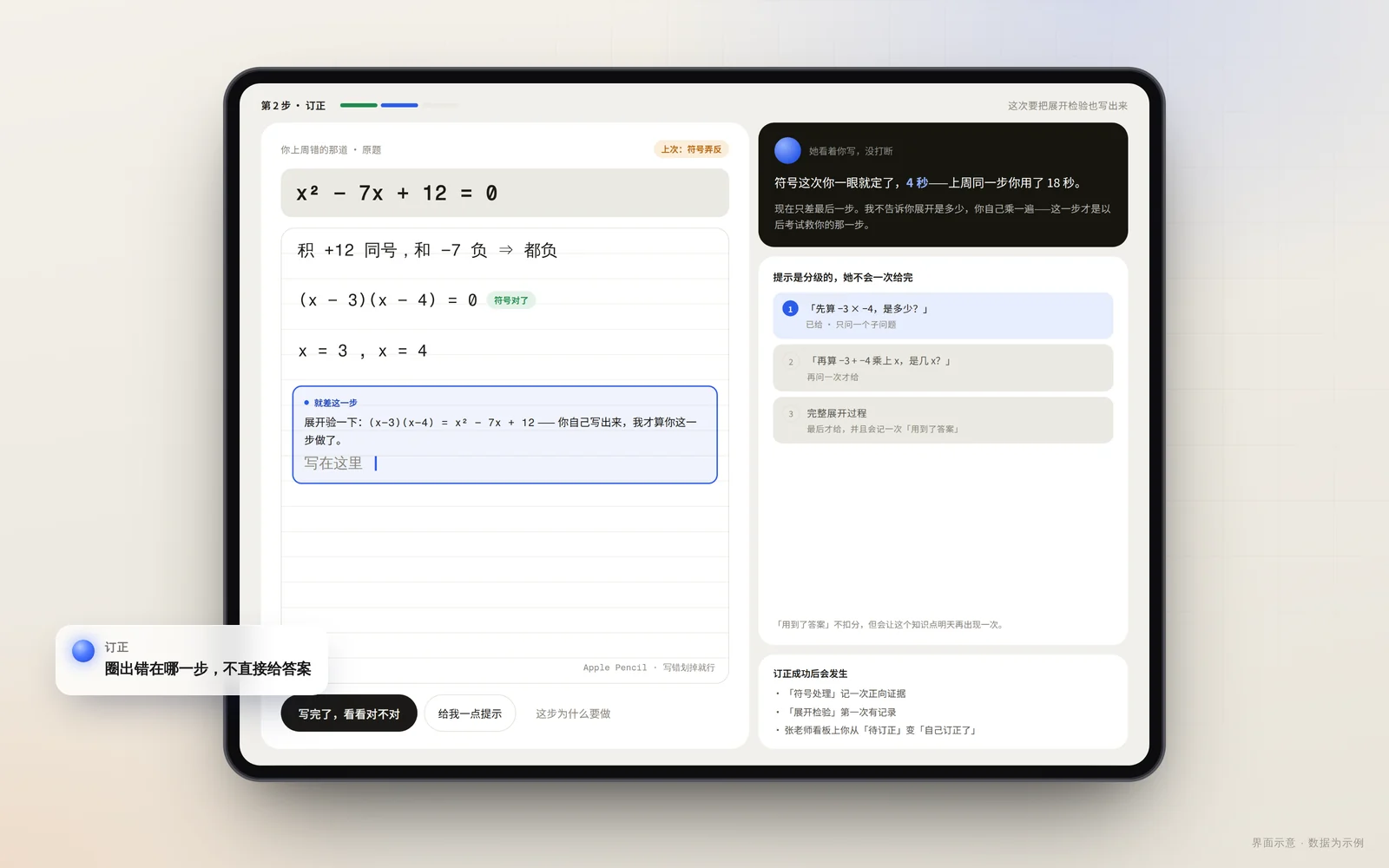
A problem won’t budge, so the student photographs it. Dr. Siwei recognises it and works through it step by step on a blackboard, open to interruption at any point. During the correction it circles the step that went wrong, lets the student fix it, and checks with problems of the same type that it has really sunk in. Missed questions go into the mistake book, and spaced review uses the FSRS algorithm to decide when each one comes back.

These are product scenario walkthroughs showing how Think EDU works inside a real learning flow. They are not client case studies, and they do not represent outcomes from any school or student.

When homework stalls, the wrong step gets circled — not the answer handed over

The real difficulty

Answers are one search away, and copying one is enough to hand the homework in. A parent who steps in to explain often ends up doing it instead. The real problem is that afterwards, nobody can say which step the child actually got stuck on.

How Think EDU works here

Once the photo is recognized, Dr. Siwei’s default is not to hand over the answer: it first reads how the student is thinking, then opens up the sticking point with questions and step-by-step hints. Questions marked wrong are filed into the mistake book, and the review scheduler puts them back on the calendar at spaced intervals. Every step along the way becomes learning evidence, projected to teachers and parents according to their role.

What this scenario leaves behind

  • What is recorded is not a right-or-wrong mark, but how far the student got and where they stopped.
  • A missed question doesn’t vanish after one attempt; it returns to the review list on a spaced-repetition schedule.
  • One piece of evidence, three views: the student sees their own reasoning, the teacher sees where the class gets stuck together, and the parent sees a summary — each only what their role allows.

Next scenario: Preparing a lesson: AI drafts, the teacher decides

View scenario